
AHARS invites you to apply below to obtain your amateur radio credentials. AHARS has Amateur Radio trainers, and assessors who are accredited by ACMA to conduct examinations. Aspiring Amateurs who pass the appropriate examinations will be able to apply to ACMA for one of the following:
- ACMA Recognition Certificate – Foundation
- ACMA Recognition Certificate – Standard
- ACMA Recognition Certificate – Advanced
- ACMA Regulations (not required for Foundation)
Special note: Since 2003 in Australia, it is no longer a requirement to pass a Morse Code (CW) test to obtain your Amateur Radio certificate for any level.
To attend a training and examination session, please complete the form below and your details will be sent to our training coordinator Paul VK5PH. One day Foundation training sessions are conducted on either a Saturday or Sunday, between 08:30 and 16:30.
Before attending our Amateur Radio training, please read our Foundation Practical Assessment Information Slides PDF to prepare you for training day. Additional free PDF guides are listed here:
- Foundation Practical Assessment Information Slides
- Foundation Study Guide
- Welcome To Amateur Radio
- Australian Amateur Radio Regulations Handbook (not required for Foundation)
The Foundation exam consists of 25 multiple choice questions all of which will be covered in our one day training course. The pass mark is 70%, which is 18 out of 25 questions correct. Have a try for free, at the type of questions you will encounter on the day at either the…
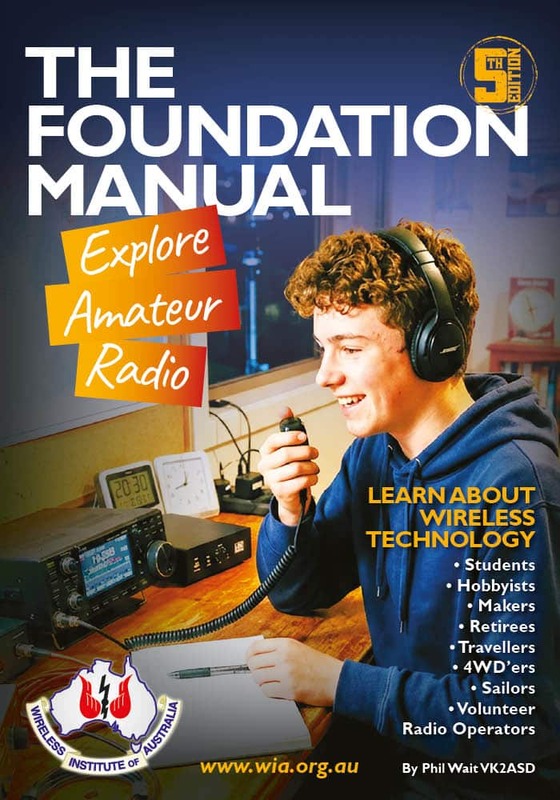
The Wireless Institute of Australia offers a printed Foundation manual. Click to go to the WIA Foundation Manual page to purchase.
More information on the Foundation qualification can be found on the WIA’s Foundation page.
What Initial Costs Are Involved?
- There is no yearly fee for the Amateur Radio operators class licence.
- You can operate an amateur station on shared frequencies as long as you hold a recognised qualification (Foundation, Standard, or Advanced level, via an ACMA recognition certificate or equivalent) and have an allocated callsign from the ACMA.
While the licence itself has no yearly fee, there are some one-time costs:
| Item | Approximate Fee (as of 2025) | Notes |
|---|---|---|
| ACMA recognition certificate application | ~$48 | Required if obtaining a new qualification (after passing an exam). Exams themselves are low-cost (AHARS $10 fee) via accredited assessors/clubs. |
| Callsign allocation (next-available) | ~$32 | One-time fee for a standard callsign. Higher fees apply for preferential or special callsigns (e.g., $44–$56). |